
💡 Introduction: Why I Started Looking at Pipedrive
After writing about Close, ChatGPT, and other AI tools, I kept hearing one name come up again and again in sales conversations: Pipedrive. Not because it’s the flashiest tool, but because it’s the one that sales reps actually like using.
With over 100,000 paying customers across 175+ countries, Pipedrive isn’t a small player . It’s earned a 4.3 rating on G2 and a 4.5 on Capterra for good reasons: the pipeline UI is genuinely intuitive, onboarding is fast, and the price is approachable .
I’ve been testing Pipedrive alongside Close and other CRMs for months. Here’s what I’ve learned.
🎯 What Makes Pipedrive Different?
It’s Pipeline-First, Not Contact-First
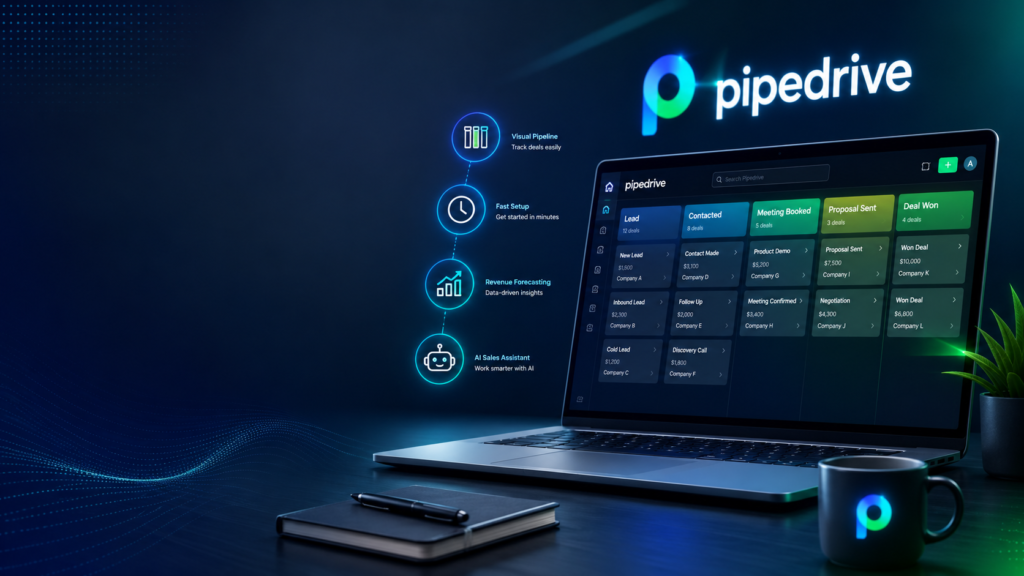
Most CRMs are designed around contacts and accounts. Pipedrive is designed around deals—the thing sales reps actually care about . The default view is your pipeline board, not a dashboard of graphs. Every click moves a deal forward .
Why this matters: Reps log activities because the pipeline makes the benefit obvious. Managers get real data because reps are actually using the tool. Most CRM adoption fails because the product serves managers, not reps—Pipedrive solves this .
A founder who reviewed the platform put it this way: “Most CRMs are built for managers who want reports. Pipedrive is built for reps who want to close deals” .
Fast Setup and Low Training Costs
Sales reps can master Pipedrive in hours rather than weeks, dramatically lowering training costs and adoption friction for SMB and mid-market teams that don’t need enterprise complexity .
Strong International Footprint
Pipedrive’s European origins and Tallinn engineering team have produced strong localization, multi-currency support, and EMEA market features that US-first CRMs sometimes treat as afterthoughts .
📊 Pipedrive Plans & Pricing in 2026
Pipedrive currently offers five tiers, with annual billing pricing as follows :
Important Note: Monthly billing costs 30-51% more than annual. A 5-person team on Growth paying month-to-month spends $195/month, while the same team on annual pays $120/month—that’s $900/year extra just for not committing upfront .
💰 The Real Cost: Add-Ons That Add Up
Here’s where Pipedrive’s pricing gets interesting. The $14 sticker price is real, but most teams need add-ons to get a complete sales stack .
Example: A 5-person startup on Lite ($14/user = $70/month) adding LeadBooster ($32.50) and Web Visitors ($49) = $151.50/month—more than double the advertised base price .
For a 10-person team on Growth ($24/user = $240/month) with LeadBooster ($32.50) + Zapier ($20–$69) = **$290–$340/month** or **$3,480–$4,080/year** .
🤖 Pipedrive AI: Sales Assistant & Pulse
Pipedrive’s AI stack is Sales Assistant plus Pulse—a recommendation and insights layer. Think win-probability scoring, deal-rot alerts, next-best-action nudges, and an AI email writer .
What it does:
- Suggests deal coaching and next-best actions for reps to review and approve
- AI-powered report generation
- Email recommendations
Where it lags: Pipedrive’s AI is solid but rolls out behind HubSpot Breeze, Salesforce Einstein, and pure-play AI sales tools, partly because Pipedrive prioritizes simplicity over rapid AI feature expansion .
According to Close’s comparison, “Pipedrive Pulse is a sidebar of nudges” while competitors like Close’s Chloe are “agents that read your CRM and take action” .
⚖️ Pipedrive vs. Close: The Honest Comparison
Where Pipedrive Wins
- Pipeline visualization is cleaner. The drag-and-drop pipeline board is the best sales view under $100 per seat .
- More integrations. Pipedrive publishes roughly 500 marketplace apps .
- Lower entry price for simple use cases. For solo founders with no outbound calling, Pipedrive wins on price and fit .
Where Close Wins
- Native calling, SMS, and email. Since Pipedrive killed its native dialer in 2022, every outbound team on Pipedrive pays for Pipedrive plus Aircall/Kixie/JustCall plus an SMS tool plus an AI notetaker .
- AI takes action, not just nudges. Chloe Voice dials, qualifies, and books directly from your CRM. Pipedrive Pulse is recommendations you have to act on .
- Support answered by humans. Close support is free on every plan, answered by an in-house team with average resolution under two hours. Pipedrive’s support is one of the loudest complaint themes across G2 and Capterra .
- Price on total. For a 10-rep outbound team, Pipedrive Advanced ($29) + Aircall ($30) + LeadBooster (~$32.50) = ~$62/seat/month. Close Growth = $99/seat/month with everything baked in .
The Honest Take from a Founder
According to a May 2026 Reddit thread cited by Close’s team: “Close tends to excel for teams that are heavily engaged in cold calling, outbound sequences, sales automation, high-volume follow-ups. On the other hand, Pipedrive is often preferred for its user-friendly interface and is particularly beneficial for pipeline visibility, deal tracking, smaller teams, quick adoption” .
🎯 Who Is Pipedrive For?
Choose Pipedrive If:
- Your team has a clear, repeatable sales process with manageable stages
- Pipeline visibility and deal tracking are your primary needs
- You want a CRM your reps will actually use (simplicity is the point)
- Your team is small to mid-sized (under 50 reps)
- You’re not heavy on cold calling (calling is a secondary motion)
Skip Pipedrive If:
- Your team spends significant time on outbound calls (you’ll pay for multiple tools)
- You need marketing automation (it’s limited vs. HubSpot)
- You’re a large enterprise with complex, multi-department processes
- You want an AI that takes action, not just suggests
💡 My Honest Take
Pipedrive is the best CRM I’ve found for teams that want a simple, intuitive pipeline view that reps actually use. It’s not trying to be everything to everyone—and that’s exactly why it works so well.
**The $14 starting price is real, but the add-on layer is where the cost jumps.** Most working sales teams land on Growth ($24) plus LeadBooster ($32.50), bringing the effective price closer to $56/seat/month—still competitive, but double the entry price.
The AI is useful, but not as advanced as competitors. Pipedrive’s Sales Assistant provides good nudges and recommendations, but it doesn’t yet have the autonomous capabilities of Close’s Chloe or HubSpot’s Breeze .
The support quality is a genuine concern. Multiple reviews cite long waits, chatbot deflection, and no phone support on lower tiers. If that’s a dealbreaker, read the reviews carefully before committing .
Bottom line: Pipedrive is a specialized tool for a specific job—helping small to mid-sized pipeline-first sales teams close more deals. If that’s you, it’s worth the look.
Have you tried Pipedrive yet? Drop a comment with your experience!
Want to discover more AI tools?
Check out all our in-depth reviews, comparisons, and tutorials on the AI Shortcut LAB Blog. Stay ahead in 2026 with the best AI tools!
AI Shortcut LAB – Your Shortcut to the Best AI Tools.